






By Nokwanda Ncwane
Ukhozi FM social commentator Nco Dube says the continued recycling of familiar political figures, factional battles and politicians facing corruption allegations risks further alienating young South Africans ahead of the 4 November 2026 local government elections.
His comments follow the appointment of former eThekwini Municipality mayor Zandile Gumede as the uMkhonto weSizwe (MK) Party’s deputy convenor in KwaZulu-Natal. Gumede was unveiled alongside several former African National Congress (ANC) members who have defected to the Jacob Zuma-led party during a media briefing earlier this month.
According to Dube, younger voters are increasingly looking for political alternatives rather than returning to familiar political personalities.
“Young people carry no liberation nostalgia and no emotional loyalty to ANC history.
“They want political spaces that feel new, ethical and forward-looking. Moves like this remind them that the old political class is still fighting its old wars, and they want out.”
Dube believes high-profile political defections could influence where younger voters place their support, particularly those seeking alternatives to South Africa’s traditional political parties.
“Younger voters are searching for political homes that offer fresh leadership without ANC baggage. That creates openings for newer parties such as Rise Mzansi and ActionSA.
“However, the MK Party occupies a unique space. It attracts disillusioned ANC supporters who still want to feel connected to the liberation movement’s ideological project.
“Voting for the MK Party allows them to reject the ANC without rejecting the National Democratic Revolution. That matters for younger voters raised in ANC households but no longer convinced by the party.”
Youth remain an underrepresented voting bloc
Although young people make up the largest share of South Africa’s population, they continue to participate in elections at lower rates than older age groups.
According to Statistics South Africa’s 2024 mid-year population estimates, people aged 15 to 34 account for around one-third of the country’s population, making young people one of the most influential potential voting blocs.
However, Independent Electoral Commission (IEC) data shows youth participation has not kept pace with their share of the population.
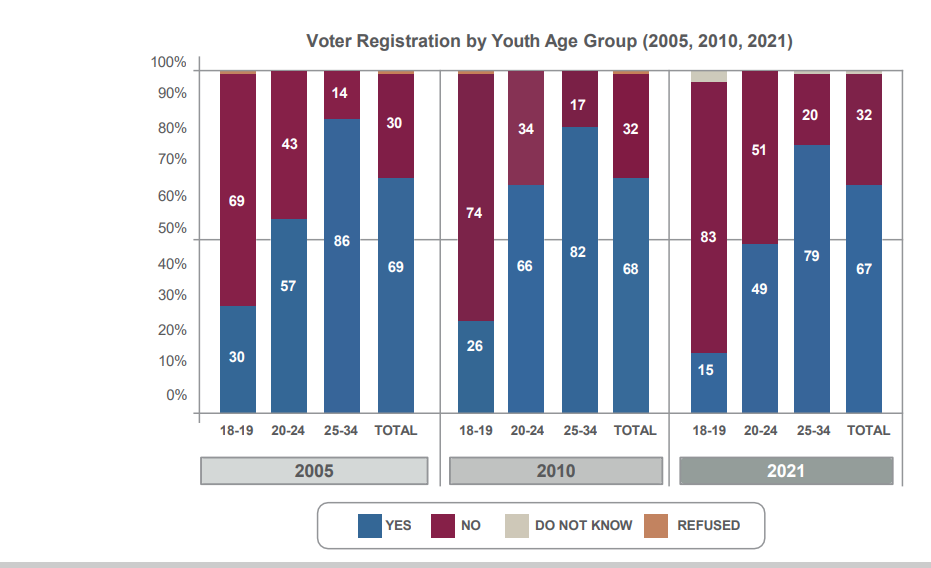
IEC voter registration figures show that registration among 18 to 19-year-olds fell from 30% in 2005 to 26% in 2010, before dropping further to 15% in 2021. Among 20 to 24-year-olds, registration declined from 66% in 2010 to 49% in 2021, while registration among 25 to 34-year-olds decreased from 82% to 79% over the same period.
Voter turnout has also declined, particularly among young adults. IEC data from local government elections shows turnout among voters aged 20 to 29 dropped from 50% in 2016 to 35% in 2021. Participation among 30 to 39-year-olds declined from 50% to 36%, while turnout among those aged 40 to 49 fell sharply from 59% to 44%.
Overall voter turnout in local government elections declined from 58% in both 2011 and 2016 to 46% in 2021, highlighting a broader decline in electoral participation across the country.

Why young people stay away
A 2026 Democracy Development Programme (DDP) study found that many young South Africans remain disengaged from local politics because of low civic literacy, limited knowledge of candidates and municipal responsibilities, and perceptions that local government is ineffective.
The study also identified socioeconomic barriers, including high youth unemployment, migration for work or study, transport costs and time constraints, as factors that often make voting a lower priority.
To improve participation, the DDP recommends that the government and the Independent Electoral Commission expand mobile voter registration drives, introduce temporary polling stations in youth hubs and informal settlements, and consider extending voting hours to reduce logistical barriers.
The organisation also recommends strengthening civic education through multilingual campaigns on social media, as well as partnerships with schools, universities and youth influencers to explain the role of local government and encourage greater electoral participation.