


By Nhlakanipho Mnqayi and Ndumiso Khuzwayo
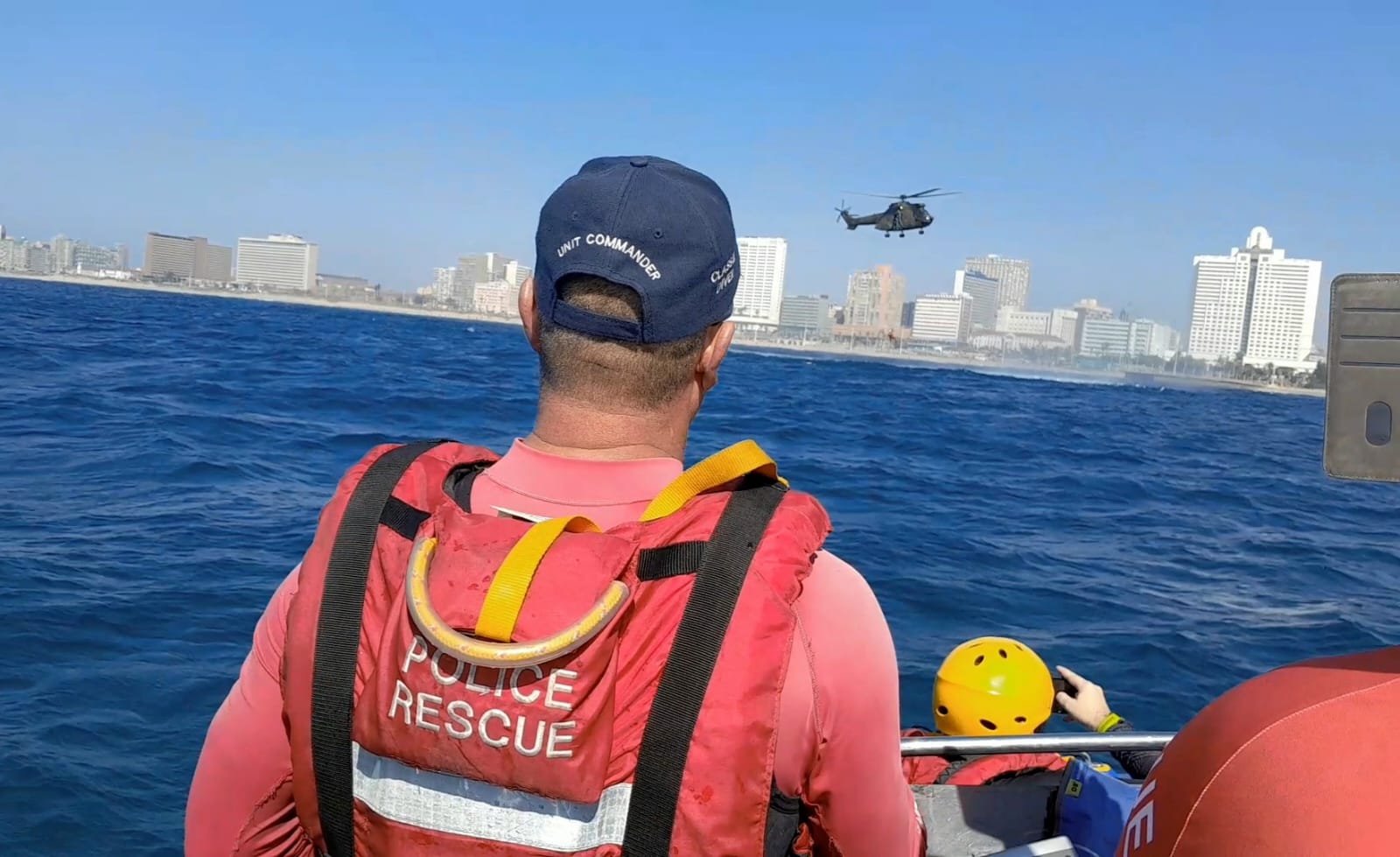
Emergency response teams conducted a disaster preparedness exercise at Durban’s North Beach on Saturday, simulating a plane crash into the ocean.
The National Sea Rescue Institute (NSRI) Station 5 in Durban, in conjunction with the South African Navy, South African Air Force, South African Police Service (SAPS) and Port of Durban personnel, took part in the exercise.
Residents and visitors around North Beach witnessed increased emergency activity offshore as helicopters, boats, divers and emergency response teams participated in the simulation.
The exercise was designed to test the coordination and response capabilities of search and rescue personnel, disaster management teams, police and security services and medical responders in the event of an aviation-related emergency at sea.
The simulated crash took place approximately 200 metres east of the shark nets, where participating teams carried out a mock casualty recovery operation.
The drill provided an opportunity for the various agencies to assess their readiness, practise inter-agency communication and strengthen emergency response procedures.
Exercises of this nature are used to improve preparedness for real-life emergencies and ensure response teams can act swiftly and effectively when public safety is at risk.
Speaking to Credible Source, Base Operations Officer at Naval Base Durban Kenneth Singh said the exercise was aimed at testing interoperability between different state organs and assessing the search and rescue capabilities of organisations operating along the KwaZulu-Natal (KZN) coastline.
The search and rescue operation was led by the Transnet National Ports Authority (TNPA).
“I think we served past our expectations in terms of achieving search and rescue. There are a number of entities we have within KZN who are all critical and play a vital role to ensure the success of search and rescue. Given that the coastline is vast, it is important that we have interoperability, that we can put the resources together and achieve a desired objective, which is saving lives,” said Singh.
He added that the organisations would ideally like to conduct similar exercises more frequently.
“Ideally, we’d like to achieve that twice a year, but due to organisational commitments and the employment of assets, it is not a cheap event. For us to employ any state asset requires funding as well as qualified personnel. The availability of such people to execute the exercise has to be perfectly orchestrated with precision planning so that the objective can be realised,” said Singh.
Harbour Master at the Port of Durban Captain Brandon Adamson said that, as Durban is regarded as one of the busiest ports, it is important that personnel are properly trained and competent in their respective roles.
“The requirement on our side is to ensure that import control, we have vessel traffic controllers that are trained and ready. We rely a lot on the Maritime Rescue Coordination Centre (MRCC), and they do a lot of training for on-scene commanders, search and rescue, and advanced search and rescue,” he said.
Adamson said the port also relies on various organisations and emergency response units during search and rescue operations.
“We rely a lot on the National Sea Rescue Institute (NSRI), rescue units that we deploy such as the South African Navy, South African Air Force, lifeguards, Emergency Medical Services, etc.,” he said.
The exercise brought together multiple emergency and security agencies to assess their ability to work together during a large-scale maritime emergency and strengthen the region’s disaster preparedness.
