


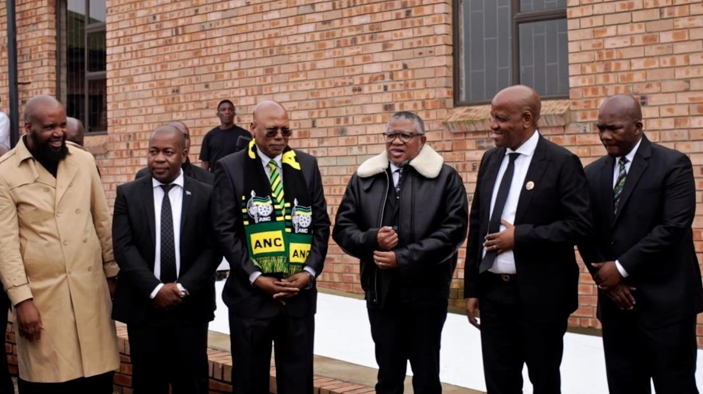
When President Cyril Ramaphosa announced the formation of South Africa’s Government of National Unity (GNU) in June 2024, longstanding political rivals agreed to govern together. A year later, the African National Congress (ANC) and Democratic Alliance (DA) continued to clash over land policy while cooperating on the national budget.
This reflects the nature of the GNU, which has sought to balance political differences with the need for stability.
The GNU followed the May 2024 general election, in which the ANC secured 40.18% of the vote, losing its parliamentary majority for the first time since 1994. After negotiations, ten parties signed a Statement of Intent on 14 June 2024, committing to priorities including job creation and good governance.
President Ramaphosa described the arrangement as a government of the people, while DA leader John Steenhuisen argued that cooperation was necessary to promote stability. Wits University political studies researcher Dr Susan Booysen said the GNU was driven less by shared ideology than by political necessity, with alternatives potentially risking economic instability.
The formation of the GNU was followed by positive market reactions, including a stronger rand and gains on the Johannesburg Stock Exchange. However, maintaining cooperation among political rivals proved challenging.
One major dispute concerned the Expropriation Act, signed by Ramaphosa in January 2025. The DA challenged the legislation in court, arguing that its provisions could threaten property rights and investor confidence. Despite the disagreement, both parties remained in government.
The DA also opposed the Basic Education Laws Amendment Bill and National Health Insurance Act, arguing that they could give the state excessive power and be costly to implement. Both became law with support from the ANC and other parties.
Budget negotiations presented another challenge when the DA opposed a proposed VAT increase in February 2025. The dispute threatened the GNU’s stability, but a revised budget was approved in April. Finance Minister Enoch Godongwana described it as a “compromise budget for a compromise government”.
Service delivery remains the real test
In KwaZulu-Natal, residents are more concerned about service delivery than political disagreements. SALGA KwaZulu-Natal chairperson Cllr Xolani Dube said the GNU offered an opportunity for parties to work together, but warned that cooperation at national level must translate into better municipal governance.
Although collaboration among the ANC, DA and IFP has supported some provincial stability, residents continue to face potholes, water interruptions and infrastructure challenges. Dube said the upcoming local government elections would test whether coalition politics could improve municipal performance.
Residents have expressed similar frustrations. A student from Newcastle said her priorities were graduating and finding employment, while a Dannhauser spaza shop owner welcomed the end of load shedding but remained concerned about rising food prices. A Durban taxi driver pointed to poor roads and crime as issues requiring urgent attention.
These concerns reflect a May 2026 Social Research Foundation survey cited in the article, which found that 48% of South Africans believed the GNU had made no difference to their lives, while 31% felt otherwise.
Experts have offered mixed assessments. Nelson Mandela University’s Dr Ntsikelelo Breakfast argued that the GNU had prevented a political crisis, although consultations had slowed decision-making. Economist Levy Ndou, however, said disagreements in Parliament and the courts could create uncertainty for businesses and delay investment.
Elections will test the GNU
As parties prepare for the November 2026 local government elections, their ability to govern together will face another test. The ANC and DA will campaign against each other in municipalities despite sharing national cabinet responsibilities.
Booysen warned that voters could question how parties can campaign against one another locally while governing together nationally. The challenge will be to demonstrate that political cooperation produces tangible results rather than merely preventing government collapse.
The GNU has shown that political rivals can resolve disagreements through Parliament, negotiations and the courts instead of abandoning the governing arrangement. However, cooperation has not automatically translated into improved service delivery or economic opportunities for ordinary citizens.
Ultimately, the GNU’s success will depend on whether it can improve municipal governance, create jobs, support businesses and address residents’ everyday concerns. As South Africa approaches the local government elections, voters will judge the arrangement not only by its ability to survive political disagreements but by whether it improves their lives.
